
Testing and commissioning to ramp up on megaproject
News
13 Mar 2026
With major civil construction on Cross River Rail and supporting projects nearing completion, crews are turning their attention to the rigorous testing and commissioning process required before trains can safely take passengers underground.
Before services commence through the twin tunnels beneath the Brisbane River and CBD, the Cross River Rail Delivery Authority, Queensland Rail, the Department of Transport and Main Roads and the project’s major contractors need to make sure the new underground line can operate safely and reliably.
To ensure this, a complex and comprehensive testing and commissioning process is undertaken by a range of experts from the various organisations. This involves four separate phases:
- Build and test (or equipment testing)
- Integrated testing (or system integration, which includes train tests)
- Operational readiness
- Passenger operations (or first passenger tests)
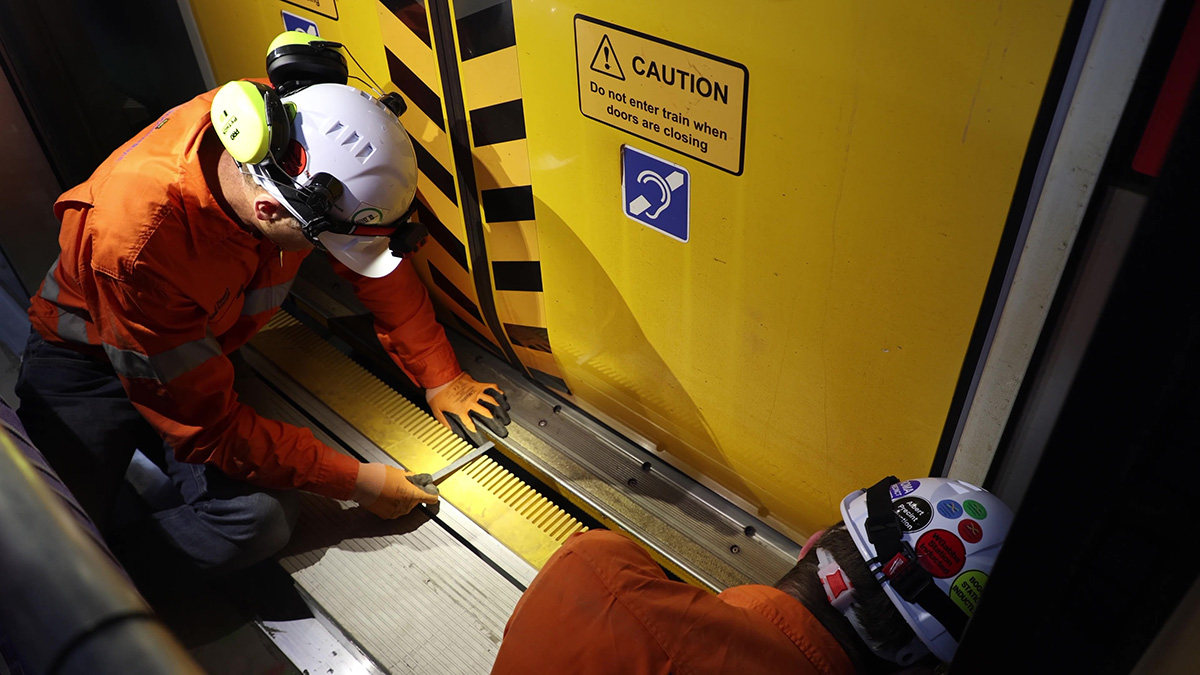
The build and test phase ensures that the thousands of individual components that have been installed in the twin tunnels and new stations have been installed correctly and work safely.
This crucial first phase checks not only civil works such as the tunnels, stations, tracks and drainage but also the installation of key components such as signalling equipment, ticketing systems, overhead wiring, power supplies, escalators and CCTV.
Thousands of new systems and subsystems will be switched on, tested and commissioned individually to make sure they work as intended on their own, both in lab conditions and on site.

The integrated testing phase is about proving that the thousands of individual parts can work together as one safe and reliable underground railway line.
It includes “dynamic testing”, where trains are run through the new tunnels and underground stations, starting with single trains at slower speeds and controlled test conditions before gradually ramping up to multiple trains under typical network conditions.
System interfaces are also tested during this time to ensure key components like the new ETCS digital signalling system can communicate properly to both trains and the Rail Management Centre.
The operational readiness phase is used to demonstrate that staff, procedures and operations are ready for passengers.
This period includes running trains to a real timetable without passengers, and training drivers and operational staff in preparation for opening. Critical safety scenarios are also tested, including evacuation procedures, emergency ventilation and fire suppression. Maintenance processes and procedures are also reviewed and tested to ensure they are fit-for-purpose as part of a safe and reliable rail line.
This phase ensures the new underground line can be run day-to-day with trained staff, working processes and proven resilience, which is required to achieve the necessary accreditation from safety regulators before opening to customers.
This includes a series of test days where people simulate passengers, including entering and exiting the stations, boarding and disembarking from trains, and travelling in both directions.
The passenger operations phase can only occur once all the previous testing phases have been successfully completed and the new underground line is ready to open to customers for reliable train operations.
From there, the new rail line is introduced to the existing network with limited first passenger services. These are increased gradually and over a period of six to nine months, to ensure the underground line can reliably operate with limited services before scaling up.
During this time, track reliability, as well as customer demand and customer feedback is all monitored closely while technical staff are on hand to address any unforeseen issues.
Network reliability, as well as customer demand and feedback, is closely monitored. Technical staff are on hand to address any unforeseen issues as they arise.
This phase eventually leads to what is known as ‘steady state’, where the new underground line is fully operational and being managed by Queensland Rail under business-as-usual arrangements.
This phase-by-phase process is expected to take about two years, which is in line with similar projects such as Sydney Metro, Melbourne Metro and Crossrail in London.
Following this process, first passenger services through the new underground line are expected in 2029.